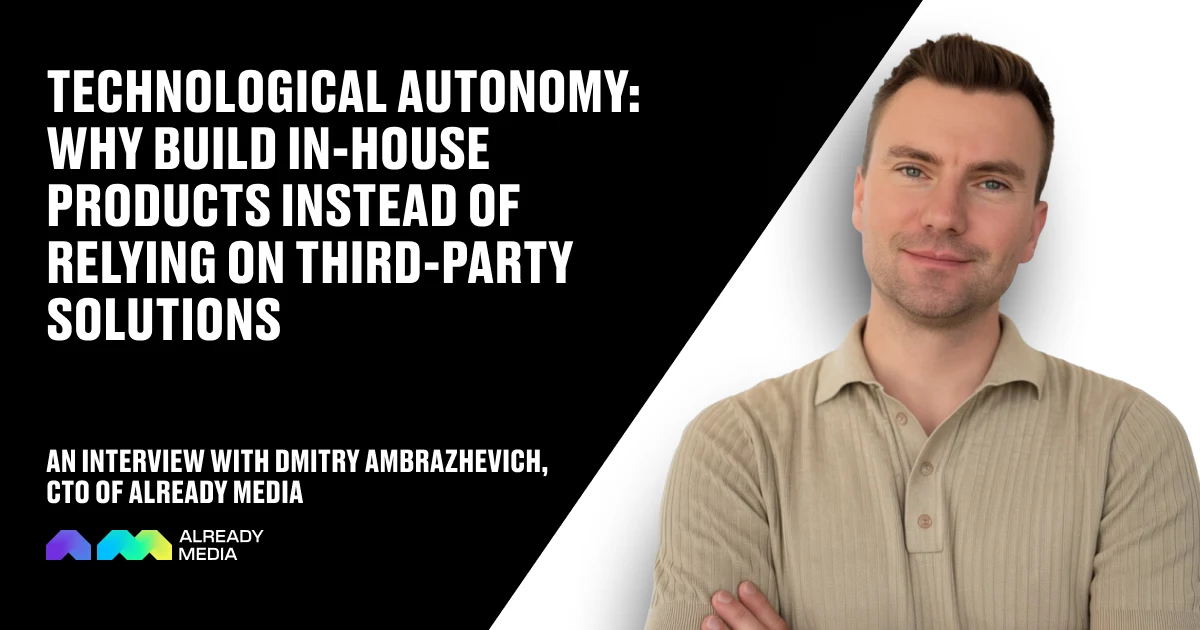
Running an iGaming business means owning your strategy. You deal with real-time data streams, react quickly to market shifts, and operate under strict security requirements. That’s why building your own internal tools isn’t just a technical preference — it’s a decision to gain what you simply can’t buy from a vendor: flexibility, predictability, and full control. In this edition of Expert Talks, we speak with Dmitry Ambrazhevich, CTO at Already Media, about how in-house development speeds up decision-making, automates core processes, and strengthens partner trust.
Business Decisions Impact
What motivated Already Media to invest in in-house development?
In iGaming, heavy dependence on external software quickly becomes a strategic risk. Before switching to internal products, we often found ourselves in situations where third-party platforms changed their terms in ways that didn’t benefit us, such as raising prices, limiting functionality, or restricting access by region. Constantly migrating between services is expensive and disruptive. It also increases the risk of losing control over your own operations. Take affiliate marketing platforms as an example. In many of them, calculations and anti-fraud logic still function as a “black box.” Switching to our own system gave us three key advantages:
- Full control over data;
- Algorithm transparency;
- Process flexibility.
When the business needs something unique, we can implement it faster than waiting for a vendor update. Partner relationships also become clearer and more efficient. Access to detailed transaction data enables us to explain any system event with confidence and clarity.
Which department usually initiates internal product requests and what are their goals?
Most of the time, requests come from business analysts, finance teams, HR, SEO specialists, affiliate managers, and department heads. Top management sometimes initiates projects, especially those involving strategic tools or risk management. In this setup, our IT team acts as an internal service partner. They help define the problem correctly, prioritize features, and propose the most effective technical solution.
How do internal products affect decision speed? Do they help identify bottlenecks?
Today, we receive real-time data, which allows us to immediately reallocate resources — scaling up promising traffic sources or quickly shutting down those that stop delivering results. Before implementing early-warning systems, we only noticed conversion drops in weekly reports. Now, our average reaction time is measured in minutes, not days. Security and auditing are another major benefit. Our internal products include detailed audit trails, so we can see who changed what, when, and why, whether the change was to settings, permissions, or financial limits. No external solution has ever provided that level of transparency.
How do you decide whether to buy or build?
We use a simple internal checklist.
It’s better to build in-house in the following cases:
And it’s better to buy ready-made tools when:
For example, we use commercial task trackers for project management, messaging apps for communication, and AWS for infrastructure. However, we develop our own affiliate platforms, analytics tools, and anti-fraud systems because these areas directly impact our competitive edge.
Development and Team Practices
How is in-house development organized at Already Media?
From day one, we consciously avoid building large, monolithic systems. Before writing any code, our team interviews future users to identify real pain points, rather than simply implementing a wish list. The first release is always a minimum viable product (MVP) designed to solve one specific problem and reach users as quickly as possible, usually within two to four weeks.
From there, the product evolves iteratively based on real feedback and usage data. We analyze metrics, run surveys, and continuously refine features according to what actually delivers value.
Who provides internal product support?
We follow the principle “you build it, you run it.” The same team that develops a product is responsible for maintaining it. This naturally encourages higher code quality and better documentation — no one wants to be woken up at night by alerts from a system they built. An on-call rotation for incident response is also in place. If an issue requires more specialized expertise, it’s immediately escalated to the relevant product team.
What makes hiring developers for internal tools unique?
We look for T-shaped specialists — individuals with in-depth knowledge of one area and a broad understanding of the entire stack. Internal products often require an understanding of everything from database architecture to UI. Transparency during the hiring process is a priority, too. Candidates know they’ll be working on internal tools rather than public-facing products. This naturally attracts people who value real business impact and direct user interaction over hype or flashy portfolio projects.
Innovations and Experiments
We are all experiencing the AI boom. Where does this technology actually save resources?
For us, AI is an efficiency multiplier, but we use it pragmatically. The most important tools in our work are:
- GitHub Copilot can handle routine coding tasks, such as boilerplate code, unit tests, and legacy refactoring. Internal metrics show a 20–30% increase in productivity, which frees up developers to focus on architecture and business logic;
- RAG-based assistants support HR and legal teams by automating responses using internal knowledge bases. Running on local language models ensures that sensitive data never leaves our infrastructure. This approach has reduced the routine HR workload by about 40%;
- LLM agents in business logic help detect anomalies in reports, such as unusual traffic spikes, suspicious conversions, and potential fraud patterns.
At the same time, we understand AI’s limitations. It performs poorly without structured data and clearly defined processes. Security remains critical — we never send sensitive information directly to public models and always use protected or private infrastructure.
How does the team test new ideas?
We maintain a flexible development culture that includes regular “Experiment Fridays.” During these days, teams share knowledge, test new tools, and build small prototypes that sometimes evolve into full products or significant feature improvements.
Future Outlook
Which areas will you focus on over the next 1-2 years?
I can mention two priorities that stand out:
- Next-level AI and machine learning — moving from isolated tools to comprehensive AI agents.
- Predictive analytics — identifying potential issues before they become real problems through pattern analysis and automated alerts.
What advice would you give to companies thinking about switching to in-house development?
In-house development is a strategic choice that transforms your entire operating model. Here are a few practical lessons from our experience:
- Honestly assess business maturity. Internal development works best when revenue and processes are stable.
- Start with a real problem, not ambition. Solve one concrete issue first to build trust and momentum.
- Invest in people, not just code. Your IT team must understand the business and its users.
- Control comes with responsibility. Ownership of uptime, scalability, and security is now yours.
- Design for scale from day one. APIs, monitoring, and documentation will prevent technical debt down the road.
- Stay connected to the market. Use open-source tools, learn from the best practices, and attend industry events.
- Measure everything. Internal tools must prove value with real metrics and ROI data.
What are the perspectives for in-house products becoming SaaS?
The line between “internal” and “external” products is already starting to blur. Low-code and no-code platforms, along with AI assistants, are lowering the barrier to development. In the near future, even non-technical product managers may be able to build working prototypes in a single day.
We also expect to see more hybrid solutions — platforms that are deployed internally but supported and updated by vendors. At Already Media, every internal product is stress-tested in real iGaming conditions. If an analytics or traffic management tool outperforms market alternatives while maintaining strong security, it becomes a candidate for software as a service (SaaS). That’s why we design with multi-tenancy and integration capabilities from the beginning.
Key takeaways
Technological autonomy isn’t an end goal — it’s a tool for building a business that can truly control its own direction. It enables data-driven decision-making instead of being limited by vendors and reduces reaction time from weeks to hours. However, autonomy requires maturity, discipline, and long-term thinking. If a company is ready for that responsibility, the path is open. Otherwise, ready-made solutions remain a practical option while you focus on your core business.
We chose technological independence because in iGaming, it’s often the only way to operate quickly enough to stay competitive — and it works well for us and our partners.