Remote work turns from privilege to challenge when you try to run a team across multiple countries. Yet, behind the daily calls, emails, and Slack reactions is a complex system of processes, rules, and human relationships. How can you effectively manage a team spread across multiple countries? What challenges arise in multi-GEO companies? What helps people feel like they’re part of the same team when they’re located on different continents? In this Expert Talks edition, we talked with Irina Dudnikova – Head of HR at Already Media – about how our company has built a workplace where people from different parts of the world feel comfortable working together.
How International Teams Are Built
Over the past four years, Already Media has grown from a small office of 20 people into an international company. When did we start hiring people from different countries, and how did that process unfold?
Initially, we were a small team that could fit into a single open space. Even then, however, Already Media had strong ambitions and clear growth potential, so the team gradually expanded. After a series of global events, some employees relocated to other countries, which marked the beginning of our journey toward becoming an international company. Business growth requires a global mindset, so we quickly decided to develop a remote team. Initially, we hired people from neighboring countries. Later, we expanded our search worldwide. Today, we look for talent in almost any location.
What was the most difficult challenge you faced?
The first thing we encountered was the difference in mindsets. In multi-GEO teams, almost everything can vary, including attitudes toward responsibility, communication styles, and the speed at which decisions are made. When working within one region, you have a good sense of what to expect from candidates. But international hiring is a completely different story. Recruiters and managers must learn the rules of the game in each country by studying local markets, adapting to cultural nuances, and understanding how people make decisions and what they value in a workplace. Over time, these differences became clearer to us. Today, we have a much better understanding of our colleagues’ cultural context, which makes it far easier to find solutions that work for both the business and the team members.
Why is a global workforce important to a company?
First, having multi-GEO teams makes a business more resilient. In recent years, the world has become far less stable due to new restrictions, economic crises, emerging technologies, and rapidly shifting markets. When a team operates across multiple countries, the company becomes less dependent on any single region. If challenges arise in one location, other parts of the team can continue working elsewhere, ensuring uninterrupted support for products and services.
Second, having a global workforce allows us to find talent anywhere in the world. This makes it easier to match people with the right expertise to specific tasks and bring strong specialists into the team.
Third, it gives us more flexibility in how we work with labor markets. A company with a presence in multiple locations can manage costs more effectively and choose the most efficient employment models for working with specialists from different countries.
Is having a diverse cultural background a challenge or an advantage for a team?
Without a doubt, it’s an advantage. International teams tend to have a better understanding of different markets, local trends, and global developments. This perspective helps us adapt marketing strategies, improve products and services, and expand into new geographic regions faster. At Already Media, people from different countries work side by side, each bringing their own professional and personal background. As a result, we approach challenges – and the world in general – with a broader perspective. This allows us to come up with more creative solutions and share best practices across the team.
The Hidden Pitfalls of Remote Work
What conditions are necessary for a multi-GEO team to work effectively?
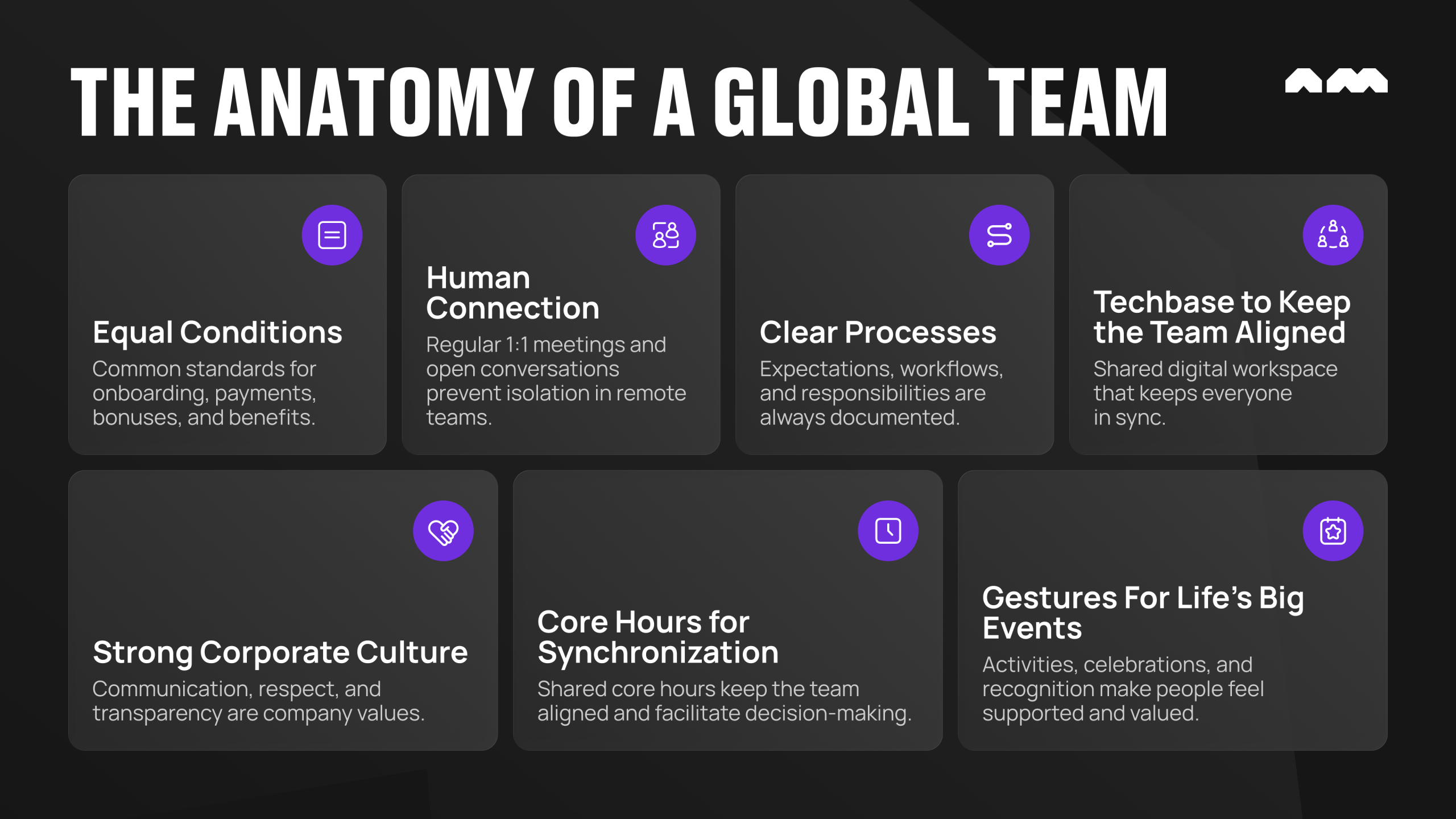
There are two levels: operational and communication. On the operational side, it’s important to build a solid foundation. This includes employee onboarding, payments, bonuses, and benefits. Everything should function consistently for people in different countries, so they feel they’re operating under the same conditions. For example, we schedule corporate events on the same dates and maintain an international holiday calendar so the team can celebrate and recharge together, no matter where they are. The second key element is synchronization. While we offer flexible start and end times for the workday, we also have several core hours when the entire team is expected to be online. This makes it much easier to resolve issues quickly, rather than waiting half a day for someone in another time zone to respond.
Another crucial factor is corporate culture. We follow the same core rules and values across all regions, including communication standards, security, and equal opportunities. However, culture isn’t just written policies. It’s reflected in how people interact every day. That’s why fostering respectful communication within the team is one of our basic principles.
How should managers prepare when their team is spread across several countries?
One thing is certain: communication increases significantly. When people work in the same office, many issues resolve themselves naturally. For example, someone might ask a quick question on the way to the kitchen or stop by a colleague’s desk to clarify something about a task. With a distributed team, this doesn’t work the same way, so processes must be clearly discussed and documented.
It’s important for managers to define expectations and agreements clearly so the team isn’t left with room for interpretation or misunderstandings. At the same time, it’s essential to maintain regular contact with team members — not only regarding work tasks, but also to understand how people are feeling in their roles. Another key aspect is understanding cultural differences. People from different countries may respond to feedback differently, approach deadlines differently, or have different attitudes toward hierarchy. That’s why leaders need to develop cultural awareness and sensitivity.
From the HR side, we actively support managers in building effective processes. We organize regular meetings, share best practices for working with distributed teams, and help develop leadership skills through training programs.
What challenges arise because of different locations, and how do we address them?
Often, the main issues are a lack of feedback, cultural differences, and a sense of isolation. When someone works remotely and is physically far from the team, they can easily feel disconnected from the overall process. That’s why we try to address these risks proactively. Employees have regular one-on-one meetings with HR and their managers, as well as clear communication guidelines and shared standards of respectful interaction within the company. We also focus on creating a shared team space. We organize online and offline meetups, lectures, and activities that employees from any location can join. Over time, these efforts help people feel like part of one team, even when they’re working from different countries.
HR Tools for Effective Multi-GEO Teams
What role does HR play in uniting employees from different countries?
HR connects teams. We don’t just build processes. We also help people feel like they’re part of the same team, even when they’re working from different countries and time zones. We try to stay connected with employees, respond quickly to questions, and provide clear information. It’s also important to understand what’s happening inside the team. This includes how the work is going, where support might be needed, and sometimes just having a conversation with people. Going a little beyond expectations, staying genuinely engaged, and caring about the team – that’s the philosophy behind the success of the HR team at Already Media.
What tools and processes help keep the team focused when employees are spread across different GEOs?
Already Media is a tech-driven company, both in terms of product development and team management. That’s why our workflows rely on a strong technological infrastructure. On the HR side, we primarily use Slack, PeopleForce, Jira, and Gmail. These tools help us communicate, assign tasks, store information, and track statuses and updates. They essentially form our shared digital workspace, keeping the team aligned and ensuring that no one loses context, even when working from different parts of the world.
How can people feel like they’re part of the same team even if they’ve never met in person?
When people feel valued, they naturally become more engaged. Let me share a few examples of how we give attention to every employee, even though our team has grown to more than 350 people. Before their first day, we ask new hires to share a few details about themselves. Based on that information, we create a short welcome video and post it in the main company chat. By the time they officially join, the team already knows who they are, what they’re interested in, and what values they share. This helps break the ice and makes it easier to find common ground. Often, this also helps newcomers quickly join internal activities, from gaming tournaments to company sports competitions. It’s a simple concept, but it significantly accelerates integration and ensures that no one feels invisible.
We also try to celebrate important moments in our employees’ lives. We prepare birthday video greetings, offer bonuses for significant life events, send merchandise for the New Year and other holidays, and organize internal contests and activities. That’s just a tiny part of what our team deals with every day. These things may seem small. But it’s these small gestures that create an atmosphere in which a large team spread across different countries can feel like one community.
Conclusion
Already Media has grown from a small team into an international company. Although our employees work in different countries, they all share the same mission. We’re definitely not stopping here. The team keeps growing, new markets are emerging, and fresh people and concepts are becoming part of the journey. Our goal is to maintain an environment in which people feel comfortable working, developing their careers, and building the company together.