Poker is gender-blind. It recognises only cold calculation, strategy, and the ability to read the game. The path for women in the industry has been long and challenging. They had to fight for visibility, respect and recognition. Today, online poker is becoming more open, with women playing an increasingly important role in its media, marketing and development. In this special edition of Point of View, we spoke with Vasilisa Zyryanova, a poker journalist and video editor, and Max Streltsov, Head of Project at PokerListings.com, about inclusivity in online poker, new career opportunities for women, and the industry’s challenges we still need to overcome.
Growing Influence
How has women’s participation in online poker changed over the past 5–10 years?
I’ve worked in the poker industry since 2008, and even then, women were part of the management teams at poker rooms, affiliate companies, and poker series. From what I remember, they made up about 20% of the workforce. However, statistics from poker websites and rooms showed that fewer than 10% of players were women. A few years later, the situation began to change, though it still depended on the segment. In management and operational roles, the percentage of women increased significantly. But at the poker tables – both online and offline – progress has been much more modest. I would still estimate that women make up around 10% of players.
According to PokerListings data, the percentage of women in the audience varies by region:
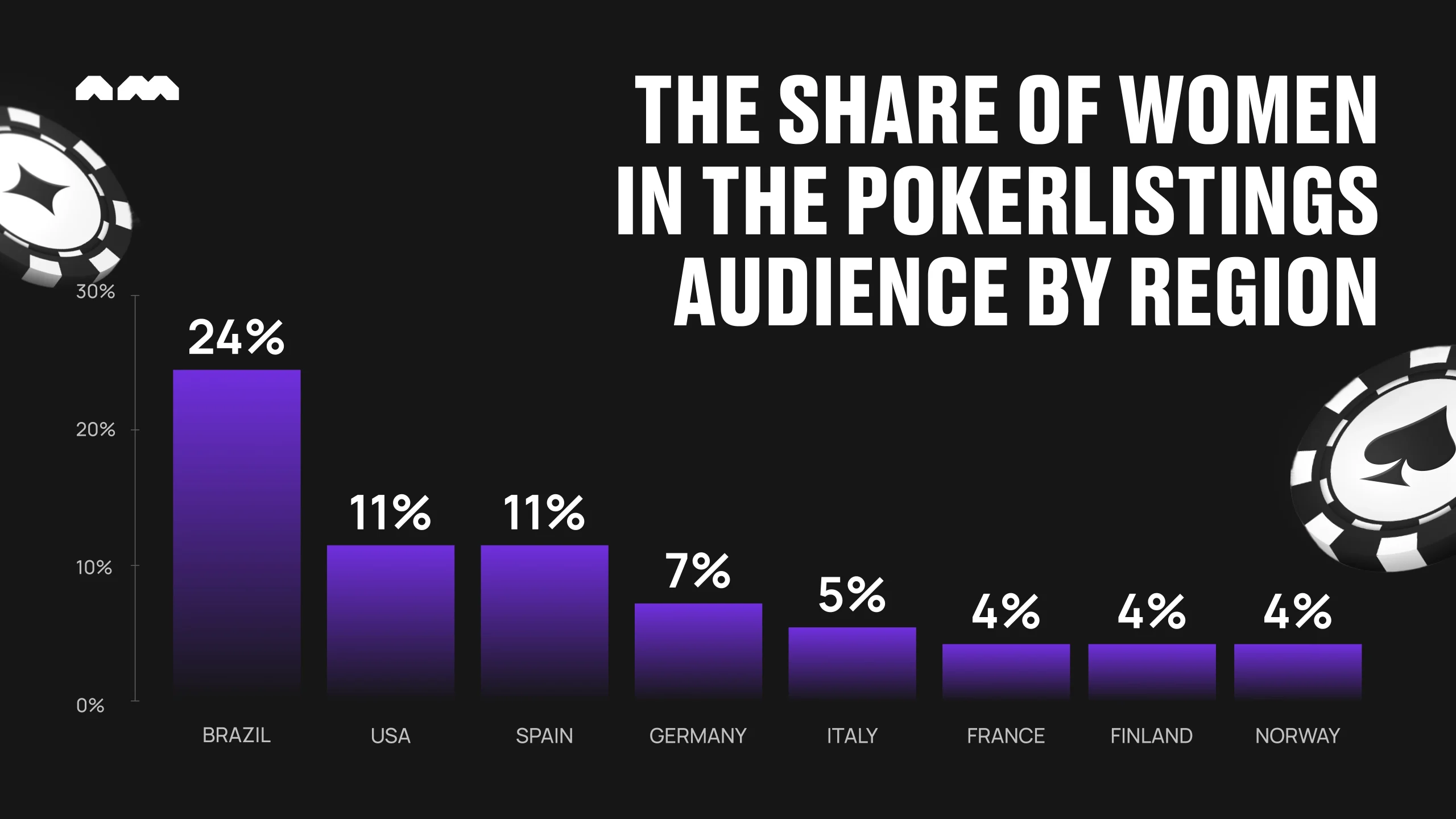
Thus, poker remains a largely male-dominated niche. But women are becoming more visible in public. More female ambassadors and streamers are appearing, including some who previously built audiences in chess. Slowly but surely, this is changing the perception of poker as a “men’s game” – even if the shift is happening more slowly than many would like. — Max Streltsov.
How well are women represented in poker media, analytics, and project management?
From what I see, women are working as journalists at live series, as writers for online poker sites, or as specialists inside poker companies. Of course, there are exceptions. Victoria Livschitz established Octopi Poker. Kristen Foxen launched her own poker app with her husband. There are also educational platforms created by women for women, a women’s poker association, and other similar initiatives. However, when it comes to positions of power and decision-making, women are still underrepresented. — Vasilisa Zyryanova.
My experience shows that the number of women in management has steadily increased over the years. At certain points, it reached 50%, including C-level roles. But the picture is different when it comes to boards of directors. Men still dominate there. This is a broader trend across many industries, and poker is no exception. In media and analytics, women are much better represented than at poker tables. At PokerListings, we’ve worked with female authors and editors who are as professional as their male colleagues – and that’s not a compliment. It’s a fact based on real experience. The most difficult situation remains at the player level. That’s where women face pressure that simply doesn’t exist in office or media environments. — Max Streltsov.
What stereotypes about women in poker do you encounter?
At the beginning of my career, the most common experience was straightforward sexism. For example, early in my career, I collaborated with a poker training school. A fairly well-known coach publicly claimed that the calculations I had prepared for an article were incorrect. His reasoning? “Girls are bad at math.” It later turned out that he had made a math mistake. Of course, he never apologized. He simply pretended everything was fine. There are several persistent myths about women in poker that still circulate.
🚩Women are worse at controlling their emotions.
From a biological perspective, this claim doesn’t hold up. Throughout history, women have demonstrated higher levels of emotional regulation, patience, endurance, and the ability to concentrate on repetitive tasks for extended periods. Evolutionarily speaking, women were expected to ensure the safety of their children. In live tournaments and cash games, however, it is usually men who engage in arguments, exhibit aggression, smash keyboards or monitors, and throw objects in frustration. Even in women-only poker tournaments, the probability of seeing something like that is close to zero. So who actually has more difficulty controlling their emotions?
🚩Women are less competitive than men.
Historically, women were often excluded from healthy forms of competition. This stereotype persists, but it doesn’t reflect reality. Look at professional sports, eSports, or any other competitive environment.
🚩Women are less willing to take risks.
Culture and social expectations play a significant role in this. Traditionally, women are expected to be responsible, careful, and risk-averse, especially when it comes to family and children. Society often judges women harshly for making risky decisions. If men had historically been expected to be the “guardians of the home,” then today, we would probably live with the opposite stereotype.
🚩Women don’t gamble.
The popularity of bridge among women in the UK, the number of lottery tickets purchased by women, and the presence of women at slot machines in casinos clearly suggest otherwise.
🚩Single women come to poker to find a husband.
Only people who have never played poker professionally would believe that. An unstable income, high emotional stress, and a partner who spends hours in front of a computer or at a tournament table without being able to take a break – that’s exactly what women are looking for in a partner, right? Especially if you’re a regular at NL2. Spoiler: No.
🚩Women don’t play themselves – their partner or husband plays for them.
I’ve lost count of how many times, after learning that my husband and I both play poker, people asked how often he “ghosts” for me. When I won tournaments, there was often skepticism because people assumed that someone else must have been playing on my account. Similar comments were made about Kristen Foxen (then Bicknell). Yet, when her partner wins tournaments, no one assumes she played for him. — Vasilisa Zyryanova.
Strategic Differences
Why do women first start playing online poker?
I think most women come for the same reasons as men. First, to earn money. Second, for entertainment – to experience new emotions and spend time in an engaging way. Third, to realize their potential. For some people, especially those involved in streaming or live tournaments, it’s also about social interaction. Poker can be a way to connect with others and feel part of a community, which can be missing in everyday life. — Vasilisa Zyryanova.
This question assumes women have a special reason to play poker. But they don’t. From my experience, there are two common pathways that bring women into professional poker. The first is working in a related role within the industry, which gradually evolves into playing. The second is taking a long maternity leave. During that time, many women look for remote income opportunities, and poker becomes one of the options. — Max Streltsov.
Do men and women play online poker differently?
There’s no convincing data showing that women play poker fundamentally differently from men. There’s no such thing as a ‘female playing style.’ For professionals, poker is a combination of mathematics and psychology, regardless of gender. One thing that sometimes stands out is the approach to learning. In my experience, women tend to be more methodical. They analyze hands more deeply and make fewer impulsive decisions at the table. However, these are individual tendencies rather than gender-based patterns. It’s also important to remember that women often play under additional psychological pressure because they know they are perceived differently. This factor alone can influence decision-making, especially in live games. — Max Streltsov.
Barriers and Drivers Within the Poker Ecosystem
How has the attitude toward women in online poker changed?
When I think back to poker 15 years ago, I have to admit that misogyny was often treated as an industry norm. Poker rooms heavily relied on sexualized advertising, both online and offline. There was little effort to portray women as equal players. At live series events, ambassadors were often models who didn’t play poker. Their role was simply to pose with the room’s logo at the table. Today, the situation has changed. You can see this change in advertising, in the selection of ambassadors, and in how women’s tournaments are covered. Kristen Foxen is a great example. Her level of play surpasses that of many male professionals.
Poker has also become more accessible in terms of skill development. Training materials, coaching programs, and solvers have no gender barriers. The issue isn’t access to these tools. The issue is the environment, which still isn’t always comfortable. At PokerListings, about half of our editorial team is female. If you want to learn more about women in poker, past and present, take our Women in Poker quiz. — Max Streltsov.
What challenges do female players and professionals still face?
In poker-related work, a significant challenge is having to consistently demonstrate your professional competence to male colleagues. Some of them simply ignore you because they subconsciously assume that they know more than you do. They don’t treat male colleagues the same way, even when the person questioning you clearly has less knowledge or experience on the subject.
It’s exhausting and frustrating, and sometimes it makes you want to leave for a workplace where you’ll be more respected as a professional and as a person. In online poker itself, there aren’t usually major issues until people find out you’re a woman. Once opponents or other players find out, you may receive negative comments or unwanted messages because of stereotypes.
Of course, sometimes reactions are positive. However, toxic behavior appears much more frequently. Before I disabled incoming messages, men from poker chats would constantly write to me, trying to “get to know me better.” They weren’t interested in my poker skills or my work in the industry. Women who play poker also face stronger social judgment. Society expects something different from us.
In live poker, women face similar challenges to those they encounter outside of poker, such as harassment, aggression, and dismissive comments based on gender. While you can sometimes ignore offensive remarks, harassment and aggression can destroy your desire to play poker outside your home or at women’s events. Health and safety matter more. — Vasilisa Zyryanova.
What are poker rooms doing right today and where are blind spots? How can the industry attract more women to online poker?
The basics have existed for a long time, and they work. Women’s tournaments have been held at the WSOP since 1977. The field continues to grow. In 2025, 1,368 women participated in the event, setting a new record for the largest field in its history. Since 2013, the buy-in structure has also changed. Men who wish to enter must pay $10,000, while women pay $1,000. Not a single man has won the tournament in all that time. This format creates a protected space, and it genuinely works.
Poker rooms are gradually moving away from sexualized advertising and increasingly working with female ambassadors who play poker. This is not just a marketing trick. It signals who the game is meant for. At the same time, not enough is being done to limit toxic behavior toward women in chats and comments. While poker rooms have learned to combat collusion and bots quite effectively, harassment remains a much more poorly addressed issue. In reality, this is a technical and managerial challenge that can be solved.
Another question is whether poker needs special marketing for women. My position is no. We shouldn’t try to create “poker for women.” Instead, we should eliminate the factors that make regular poker uncomfortable for women. — Max Streltsov.
Trends and Expectations
What will the role of women in online poker look like in 3-5 years?
I believe the number of women will grow, although my female colleagues tend to be more skeptical. My view is based on long-term WSOP data. The number of participants in the Women’s Event has grown dramatically: 93 in 1977 and 1,368 in 2025.
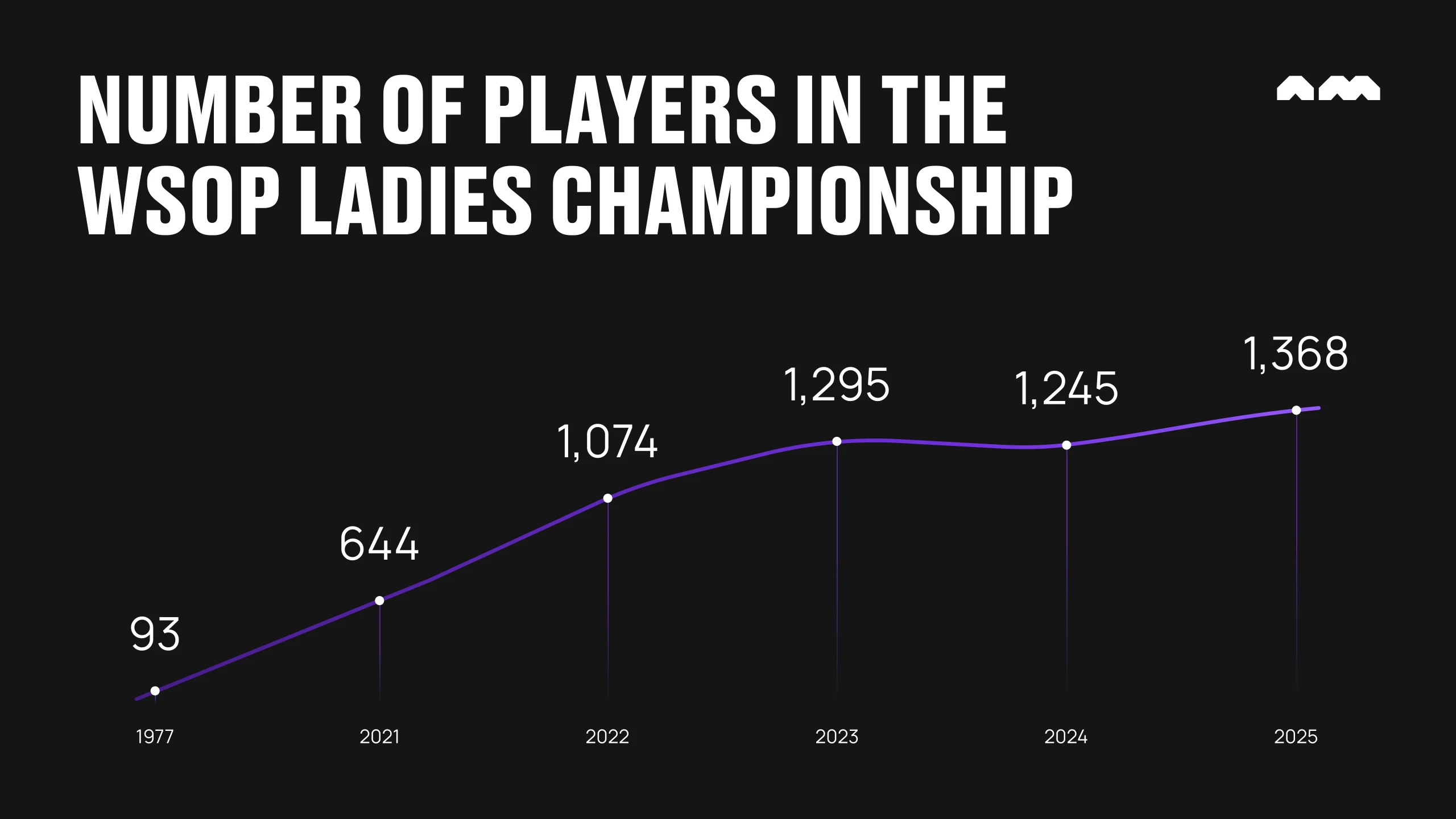
The growth isn’t linear, but the trend is clear. Online poker has lower barriers, objectively. You don’t need to visit a casino in person. Backers evaluate statistics, not gender. Poker schools are open to everyone. Technically, the environment is already neutral. The question is when that will translate into actual numbers at the tables. — Max Streltsov.
Who will drive change: the community, the media, or the poker rooms themselves?
Poker is a small niche. It doesn’t create social trends, but it follows them. When society changes its view of what constitutes a ‘male’ or ‘female’ space, that eventually affects poker, too. Every participant in the industry plays a role. Poker rooms control the environment and advertising; that’s their responsibility. The media decides who becomes visible and whose achievements are recognized. The community defines the tone. Change here happens slowly because it depends on people rather than corporate policies. However, poker rooms probably have the greatest influence because they have the motivation and tools to expand the market. — Max Streltsov.
What should the industry do to become more inclusive?
Poker rooms should promote poker as a gender-neutral space where anyone can compete, win, and have a great time. Poker has a unique opportunity to be inclusive rather than exclusive, as it has been for many years. The media should also cover all players’ achievements equally and stop emphasizing when a woman wins, unless it’s a historic milestone, such as the first woman to win a series or the first female Main Event champion. — Vasilisa Zyryanova.
My focus is on the environment. There should be less sexualized advertising. Better moderation of toxic behavior in online chats. We need to normalize the presence of women at the tables without treating it as something unusual. It’s not about ‘women’s poker’ as a separate product – it’s about poker as a game where everyone feels comfortable. — Max Streltsov.
Conclusion
Visibility, equal opportunities, and an absence of discrimination are more than just appealing phrases for marketing strategies or industry media pages. They are the result of countless small, everyday actions that gradually create a safer and more comfortable environment for everyone. However, if each community member does not view women as equal opponents, no top-down initiative will be effective. Real change begins with attitudes, not regulations – and those attitudes ultimately define the culture of the game.